
.png)
Fae, Fairies, Pixies, Elves, and Sprites: What's the Difference?
- 4 days ago
- 5 min read

If you've ever read a fantasy novel, watched a fairy tale movie, or explored Celtic mythology, you've probably come across names like fae, fairies, pixies, elves, and sprites. They often seem interchangeable, but in folklore, mythology, and modern fantasy, they each have unique histories and characteristics.
The confusion exists for a good reason. Many of these legends evolved over hundreds—sometimes thousands—of years as stories spread across Ireland, Scotland, England, Wales, Scandinavia, Germany, and beyond. Over time, the creatures blended together, changed names, and inspired entirely new versions in literature.
So, what are the real differences?
Let's step into the fascinating world of European folklore.
What Does "Fae" Actually Mean?
Today, many fantasy books use the word fae to describe an entire race of magical beings.
Historically, however, the term is much broader.
The word fae (also spelled fay or faerie) comes from Old French and ultimately traces back to the Latin word fata, meaning "the Fates." In medieval literature, faerie often referred not only to magical beings but also to the enchanted realm they inhabited.
Think of fae as an umbrella term.
Fairies, brownies, pixies, sprites, redcaps, and many other supernatural beings can all fall under the broader category of the fae.
Modern fantasy novels have expanded the term even further. Today, readers often imagine the fae as beautiful, immortal, powerful beings who live in magnificent courts and kingdoms. While inspired by folklore, this image owes just as much to modern fantasy as it does to ancient legend.
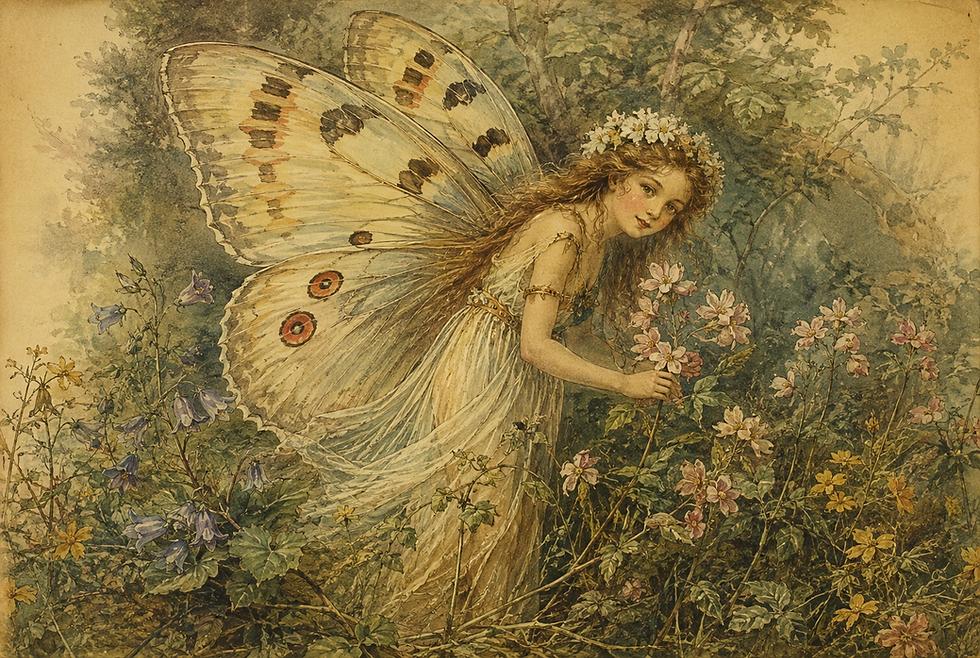
Fairies: Far More Than Tiny Winged Creatures
Ask someone to picture a fairy and they'll probably imagine a tiny woman with butterfly wings floating through a flower garden.
Ironically, that's one of the newest versions of fairies.
In traditional folklore, fairies were often human-sized—or even taller—and they weren't necessarily kind.
Many stories describe them as mysterious beings living beneath ancient hills, inside forests, beside rivers, or within hidden kingdoms invisible to ordinary people. Irish tradition refers to these beings as the Aos Sí ("people of the mounds"), supernatural inhabitants connected to ancient burial hills and sacred places.
Fairies could bless travelers...
Or curse them.
They might reward kindness...
Or punish disrespect.
Many families once left offerings of milk or bread outside their homes, believing it was wiser to keep the fair folk happy than risk offending them.
In other words, the original fairies were much less like Disney characters and much more like unpredictable forces of nature.

Pixies: The Mischievous Tricksters
Pixies are most closely associated with Devon and Cornwall in southwest England.
Unlike the broad concept of fairies, pixies are a distinctly regional tradition.
According to local legends, pixies loved confusing travelers by leading them in circles across lonely moors—a phenomenon known as "pixie-led."
Imagine walking through the fog only to realize you've somehow returned to the exact place where you started.
People often blamed pixies.
Pixies were usually portrayed as cheerful pranksters rather than outright villains.
They might steal small objects.
Hide household items.
Play harmless tricks.
Or simply enjoy making humans look foolish.
The tiny winged pixie so common in modern fantasy became popular much later through Victorian art and children's literature. Earlier folklore described them in many different ways, and wings were far from universal.

Elves: Ancient Beings of Great Power
Elves are actually much older than many fairy traditions.
Their roots stretch deep into Norse mythology, where they were considered powerful supernatural beings rather than Santa's cheerful helpers.
The Poetic Edda and other Old Norse texts describe different groups of elves, including the Ljósálfar (Light Elves), who were radiant and associated with beauty, and the mysterious Dökkálfar or Dark Elves. These traditions later influenced countless fantasy worlds, from J. R. R. Tolkien to modern role-playing games.
Unlike many fairy creatures, elves were often portrayed as graceful, wise, immortal, and deeply connected to magic.
Their influence on fantasy literature cannot be overstated.
Without Norse elves, modern fantasy might never have given us the elegant archers and ancient forest kingdoms that have become genre staples.

Sprites: Spirits of Nature
The word sprite comes from the same root as the word spirit.
Historically, sprites weren't necessarily one specific creature.
Instead, they described small supernatural beings connected with nature.
Some legends speak of woodland sprites.
Others describe water sprites living beside lakes and rivers.
Some traditions even connected sprites with the air itself.
Because the word was used so broadly, one region's sprite might resemble another region's fairy.
Rather than belonging to a single mythology, sprites became a general term for magical nature spirits throughout Europe.

The Hidden World of Brownies
Although they receive less attention today, brownies were among the most beloved creatures in British folklore.
A brownie wasn't a woodland fairy.
It was a household spirit.
According to Scottish and English legends, brownies quietly worked while everyone slept.
They swept floors.
Finished chores.
Mended small problems around the house.
In return, they expected only simple gifts like cream, bread, or milk.
There was one important rule:
Never offer a brownie clothing.
Many legends say a brownie would feel insulted by the gift and leave forever.
J. K. Rowling's house-elves clearly drew inspiration from these older household spirits.

The Seelie and Unseelie Courts
No discussion of the fae is complete without mentioning the famous Seelie and Unseelie Courts.
Modern fantasy often portrays them as two opposing kingdoms:
The Seelie Court represents order, beauty, and diplomacy.
The Unseelie Court represents darkness, danger, and chaos.
The truth is slightly more complicated.
In older Scottish tradition, the word seelie originally meant "blessed" or "fortunate" and was often used as a respectful nickname for fairy beings rather than the name of a clearly defined "good" kingdom. The fully developed idea of two organized rival courts became much more prominent in later folklore and literature.
Even the so-called Seelie fairies could be dangerous if offended.
In folklore, very few fae were completely good—or completely evil.
Why Do Fantasy Books Mix Them Together?
If you've noticed that every fantasy series seems to define these creatures differently, you're not imagining things.
That's because folklore itself rarely agreed.
A fairy in Ireland might behave differently from one in Wales.
A pixie in Devon might resemble a sprite somewhere else.
An elf in Norse mythology has little in common with a Victorian Christmas elf.
Fantasy authors borrow the pieces they love most and reshape them into something new.
Some create towering immortal fae kingdoms.
Others invent tiny glowing fairies.
Some combine brownies, pixies, elves, and sprites into a single magical civilization.
There isn't one "correct" version.
That's part of the magic.
The world of the fae has fascinated people for centuries because it refuses to fit into neat categories.
Some beings protect homes.
Others guard ancient forests.
Some delight in helping humans.
Others delight in tricking them.
Together, they form one of the richest traditions in European folklore—a tradition that continues to inspire today's fantasy novels, films, and games.
So the next time someone asks whether a fairy, pixie, elf, or sprite is really a fae, the simplest answer is this:
Usually, yes.
But each carries its own history, legends, and personality, making the enchanted world of the fae far more diverse—and far more mysterious—than most people realize.



Comments